
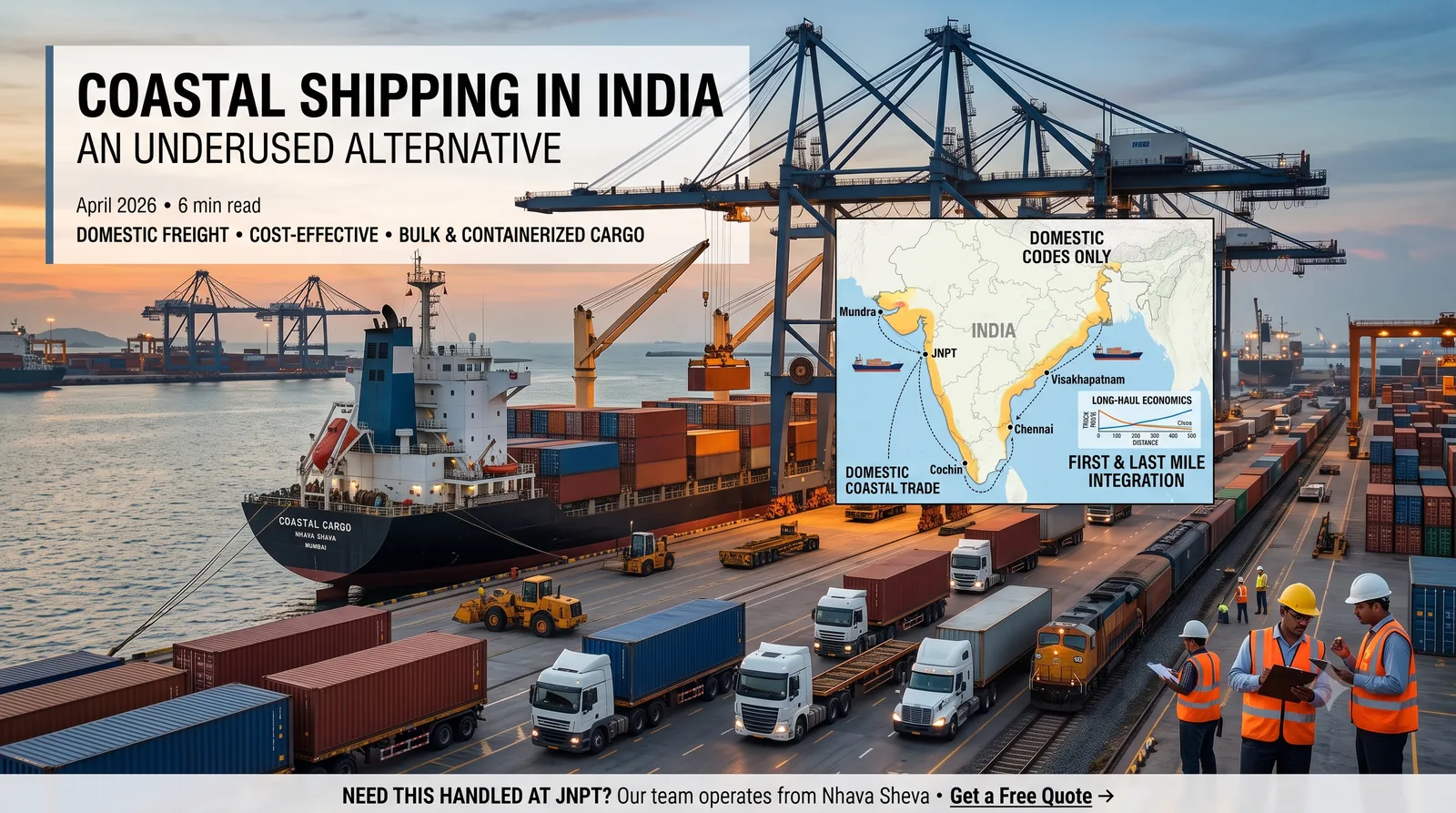
For the right cargo profile, moving domestic freight by sea can reduce cost and road congestion simultaneously.
Coastal shipping moves cargo between Indian ports without leaving national waters. It competes with long-haul road and rail on domestic lanes, particularly along the western and eastern seaboards.
Sea movement carries a high fixed cost and a low variable cost per tonne-kilometre. That shape means it rarely competes over short distances but becomes attractive as distance grows, especially for dense, non-urgent cargo.
Bulk commodities, steel, cement, and containerised cargo moving between distant coastal industrial clusters are natural candidates. Cargo that is time-critical or destined for landlocked regions usually is not.
Domestic coastal movement enjoys lighter procedural requirements than international trade, which reduces administrative friction. That advantage is real but does not by itself resolve the first-and-last-mile question.
Coastal shipping is almost never door to door. The road legs at each end determine whether the total cost beats a straight trucking option, so the comparison must be run on the full chain rather than the sea leg alone — our first- and last-mile transportation service is what typically closes that gap.
We model coastal against road and rail on total landed cost and realistic transit, including port dwell. Sometimes it wins clearly; sometimes it does not. Knowing which before committing is the point of running the comparison. Our coastal shipping service covers exactly this door-to-port and port-to-port comparison work.
Our team operates from Nhava Sheva. Send us the details and we will come back within two business hours.
Get a Free Quote →