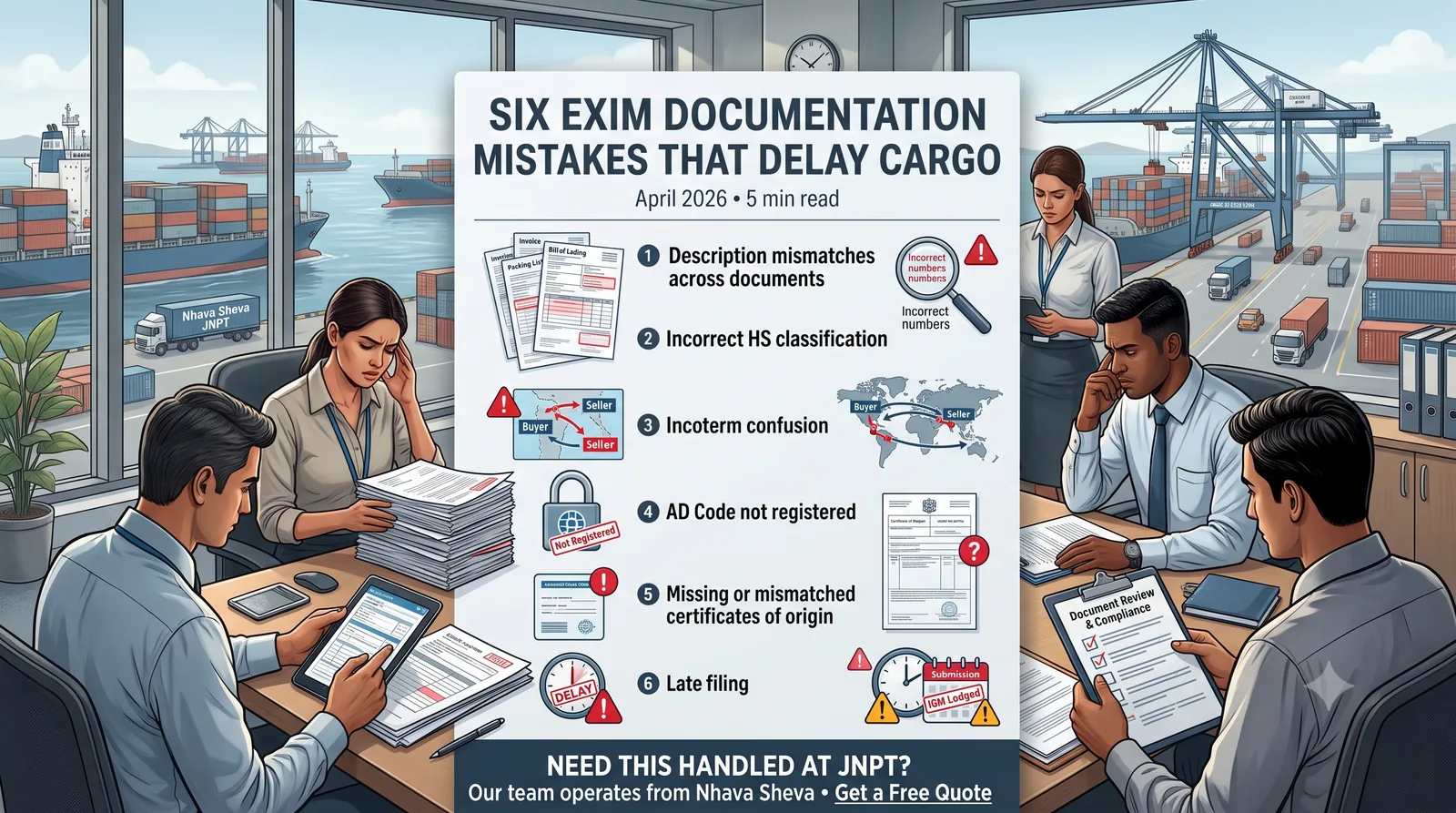
Most clearance delays trace back to avoidable paperwork errors. These are the ones we see most often.
The goods description on the invoice, packing list, and bill of lading must agree. Customs systems compare these fields, and a discrepancy that seems trivial to the shipper reads as a red flag to an assessing officer.
Classification determines duty, licensing, and whether restrictions apply. Choosing a code because it attracts lower duty rather than because it describes the goods creates exposure that surfaces later, usually with penalties attached.
Incoterms define where risk and cost transfer. Quoting one term and contracting on another leaves both parties assuming the other arranged insurance or clearance. Write the term and the named place explicitly.
An IEC alone is insufficient. The AD Code must be registered at the specific port of clearance, and completing that registration takes time that first-time importers routinely have not allowed for.
Preferential duty claims depend on a valid certificate of origin matching the consignment exactly. An expired or inconsistent certificate turns an anticipated concession into full duty liability at assessment.
Filing after arrival compresses every downstream step and can attract charges. Advance filing once the IGM is lodged costs nothing extra and removes an entire category of delay.
Each of these is a coordination failure rather than a technical one. Catching them requires someone reviewing the document set as a whole before filing — which is precisely what a document check at the point of lodgement is for. This is the same document review built into our customs clearance and brokerage service at JNPT.
Our team operates from Nhava Sheva. Send us the details and we will come back within two business hours.
Get a Free Quote →